Understand any stock in simple English
Enter a ticker to learn what the company does and how it makes money.
Fidelity MSCI Financials Index ETF
It is an exchange-traded fund that lets investors own a broad basket of U.S. financial stocks in one purchase.
This is a basket, not a business. The Fidelity MSCI Financials Index ETF holds a wide slice of American financial companies — banks, insurers, payment networks, brokers, and asset managers — and sells shares of that basket to ordinary investors on the NYSE Arca exchange. When you buy a share, you are effectively buying a tiny piece of hundreds of financial firms at once, without picking individual stocks yourself.
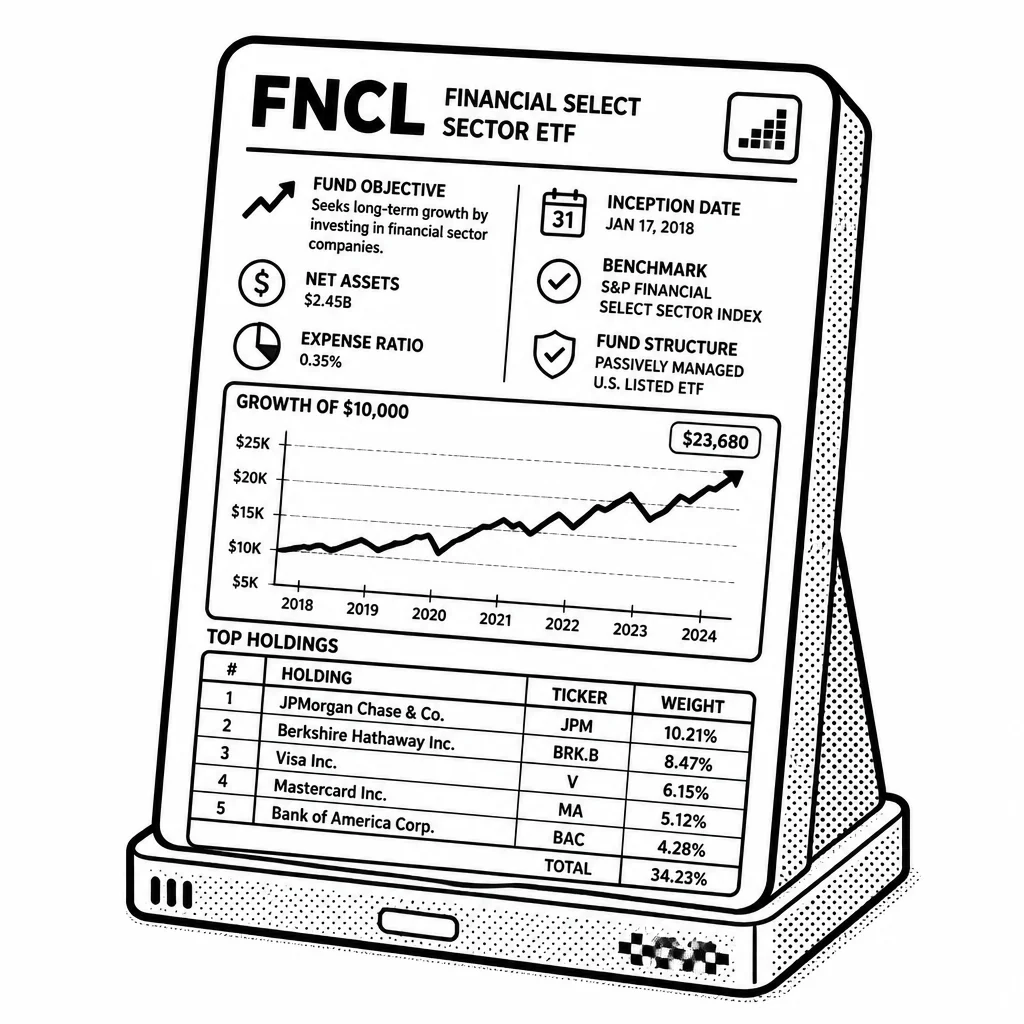
The fund is passive, meaning it doesn't pay a team of analysts to choose winners. Instead, it tries to copy the MSCI USA IMI Financials 25/50 Index, a benchmark built to represent the financial sector across large, mid, and small U.S. companies. The "25/50" part is a rule: no single holding can grow beyond a quarter of the fund, and the biggest few together can't exceed half, which keeps the basket from being dominated by one giant name. An investor gets simple, low-cost exposure to a sector that rises and falls with interest rates, lending conditions, and the health of the economy. The people who buy it are usually investors who want to tilt their portfolio toward financials or fill out a sector-allocation strategy, often inside a retirement account or brokerage. They pay a small annual expense ratio — a fraction of a percent — which is the fund's main way of earning money. Fidelity, the giant Boston-based asset manager behind it, collects that fee and in return handles the buying, selling, and tracking that keeps the fund glued to its index.
The appeal is convenience and diversification. Owning a bank stock alone means betting on one management team and one balance sheet; owning this fund spreads that risk across the whole sector. The trade-off is that you get the sector's average, not a standout, and financials are famously cyclical — they can soar when the economy hums and stumble hard when credit turns bad or rates swing sharply. It is a plain tool for a specific job, not a magic formula.
Saved answer · last researched 15 Nov 2026