Understand any stock in simple English
Enter a ticker to learn what the company does and how it makes money.
Franklin FTSE Taiwan ETF
It is an exchange-traded fund that lets investors own a basket of large and mid-sized Taiwanese stocks in a single purchase.
The Franklin FTSE Taiwan ETF is a simple wrapper that gives you a slice of Taiwan's stock market. It holds a basket of large and mid-sized Taiwanese companies and tracks the FTSE Taiwan Capped Index, so when you buy a share, you are effectively buying a tiny stake in many of Taiwan's biggest businesses at once. It trades on NYSE Arca under the ticker FLTW.
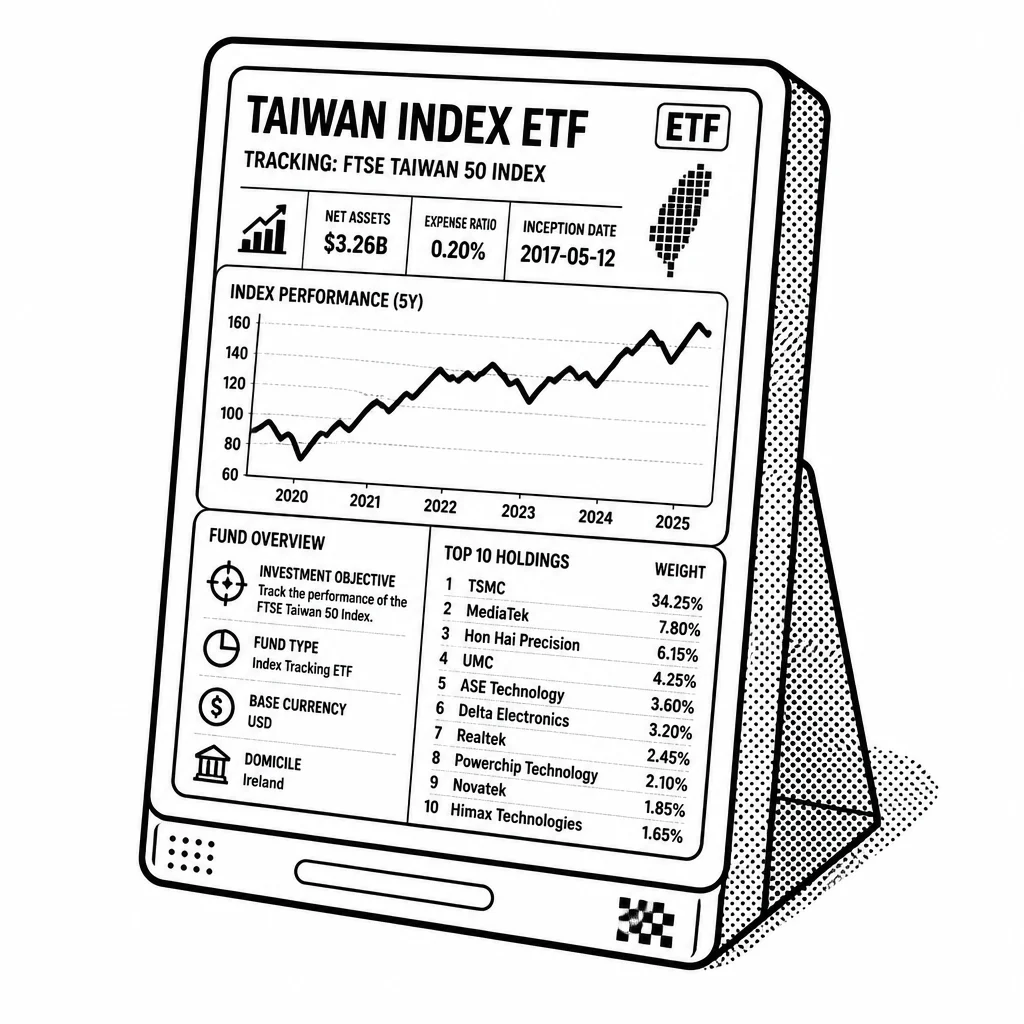
The fund exists because buying Taiwanese stocks directly is a hassle for most investors. You would need a local brokerage account, handle foreign currency, and research dozens of individual names. This ETF does that work for you: it holds the stocks, handles the mechanics, and lets you buy or sell a piece of the whole basket on a U.S. exchange during normal trading hours, just like a normal stock. What is actually inside matters more than the wrapper. Taiwan's stock market is unusually concentrated in technology and semiconductors, so this fund rises and falls largely with the global chip cycle. Taiwan Semiconductor Manufacturing Taiwan Semiconductor Manufacturing is the dominant holding, which means the fund is less a broad bet on Taiwan's whole economy and more a bet on its export-driven tech giants. That concentration cuts both ways: it can supercharge returns in a boom and magnify losses in a downturn.
The fund's appeal is convenience and cost. It is a low-fee, passively managed product from Franklin Templeton, and it gives exposure to a market many U.S. investors otherwise skip. The catch is that it is a niche, single-country fund, so it carries currency risk, geopolitical risk tied to Taiwan's relationship with China, and the plain fact that a handful of chip companies drive most of its performance. It is a tool for a specific job, not a one-stop portfolio.
Saved answer · last researched 15 Nov 2026