Understand any stock in simple English
Franklin FTSE Japan ETF
It is an exchange-traded fund that gives investors a simple way to own a broad basket of large and mid-sized Japanese stocks in one purchase.
The Franklin FTSE Japan ETF is a basket you can buy in a single click. It holds a wide spread of large and mid-sized Japanese companies — the carmakers, electronics giants, banks, and industrial firms that make up much of Japan's stock market — and it tracks an index built by FTSE Russell that aims to represent that market. When you buy a share, you are effectively buying a small slice of hundreds of Japanese businesses at once, without having to pick individual stocks or open a brokerage account in Tokyo.
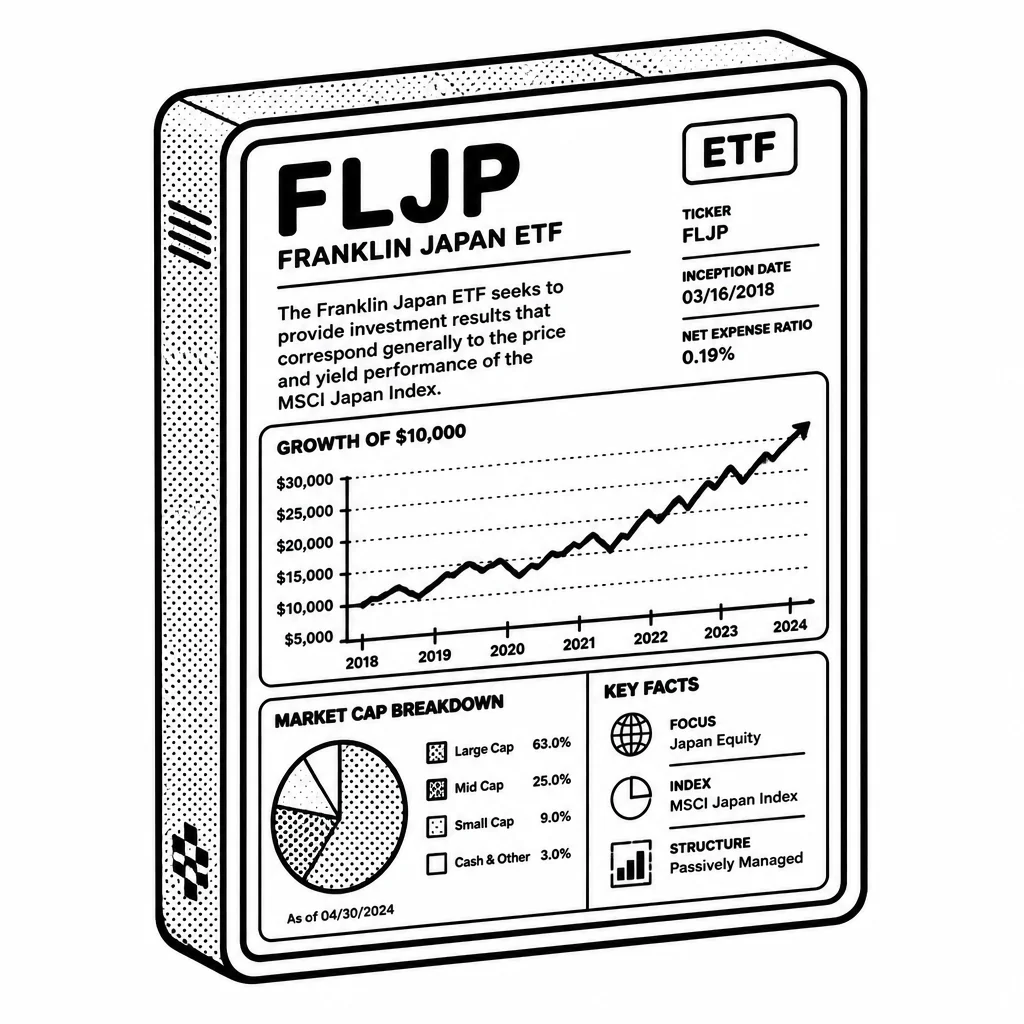
The fund is sponsored by Franklin Templeton, a large American asset manager, and it trades on NYSE Arca like a normal stock. That structure matters: you can buy and sell it any time the US market is open, and you get instant diversification across Japan in a single ticker. Investors choose it when they want exposure to Japan — perhaps because they think Japanese stocks are cheap, or because they want to spread their money beyond the US — without the hassle of currency conversion or picking winners. The index it follows caps the weight of any single company, so no one stock can dominate the fund too much. That keeps the basket balanced rather than letting one giant like Toyota or Sony swell to a dangerous size. The fund charges a modest annual fee, and like any ETF it simply passes through the returns of the stocks it holds, minus that fee. It does not try to beat the market; it tries to be the market.
The main risks are simple and honest. You are betting on Japan — its economy, its currency, and its corporate culture — and if Japanese stocks fall or the yen weakens against the dollar, your investment suffers. The fund also tracks its index imperfectly, and its returns will lag the index slightly because of fees. For a low-cost, one-stop way to own a piece of Japan, it does the job cleanly, with no drama and no stock-picking required.
Saved answer · last researched 20 Nov 2026