Understand any stock in simple English
Enter a ticker to learn what the company does and how it makes money.
Coursera, Inc.
Coursera sells online courses, certificates, and degrees from universities and companies to individual learners, businesses, governments, and schools.
Coursera is an online learning marketplace. It lets people take courses, earn certificates, and even complete full degrees over the internet, taught by professors from universities and instructors from big companies. If you want to learn data science from a Stanford professor or pick up a Google IT certificate on your lunch break, Coursera is one of the places you go.
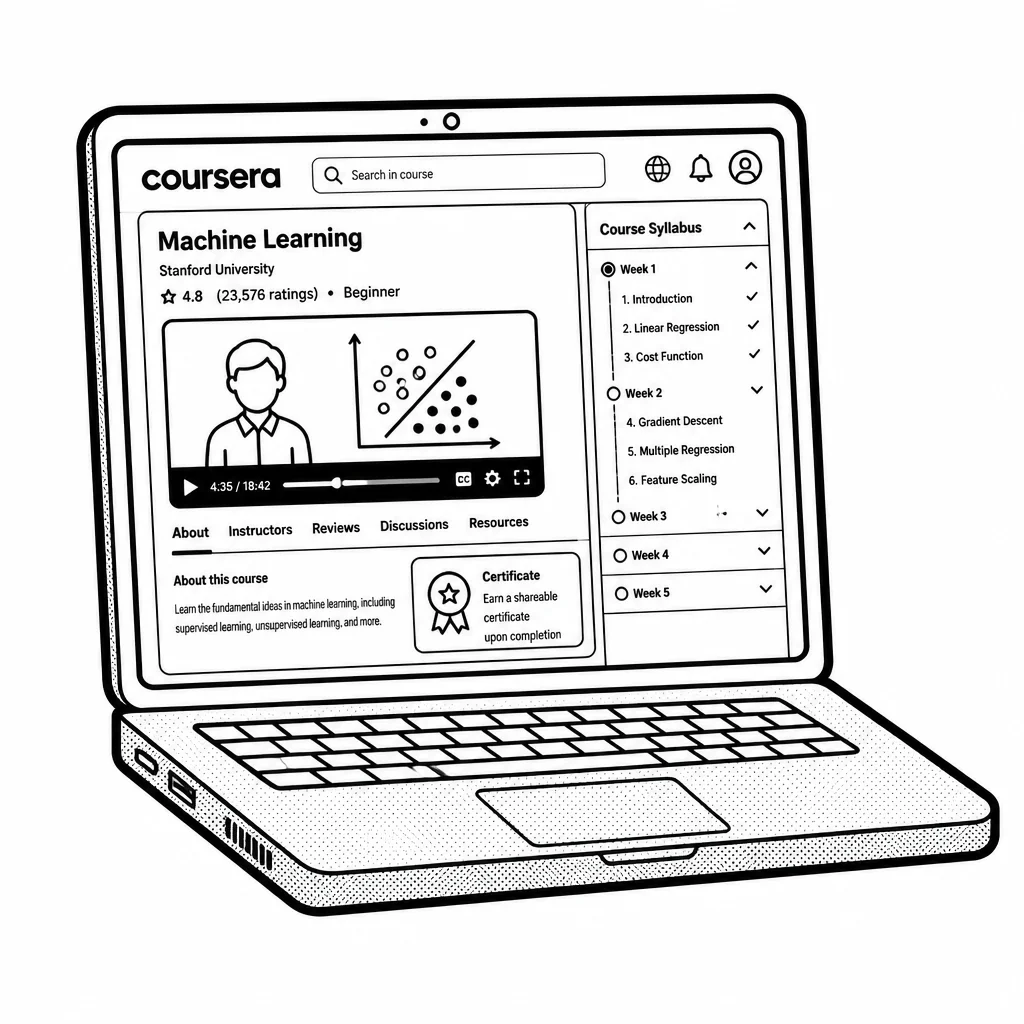
The company makes money from four kinds of customers. Individual learners pay for courses and certificates, or subscribe to Coursera Plus for unlimited access. Businesses pay to train their employees. Governments and universities pay to put their own courses online or to give their students access. The degree business is the smallest but highest-priced part: students pay tuition for full online degrees from partner universities, and Coursera takes a cut. Coursera itself doesn't create most of the content; it's a platform connecting teachers and institutions with learners, much like a shopping mall for education. The business has grown fast but has struggled to turn a profit. It reported about $694 million in revenue in 2024, up roughly 9% from the year before, and it has never posted a full-year profit. Its main rival is Udemy, another online course marketplace, though Coursera leans more on university partnerships and formal credentials. The pandemic gave it an enormous boost as everyone suddenly needed to learn from home, then growth slowed sharply once offices and classrooms reopened. Coursera has been cutting costs and pushing its enterprise and degree segments, which bring steadier revenue than one-off course purchases.
Coursera was founded in 2012 by two Stanford computer science professors, Daphne Koller and Andrew Ng, who had just watched an online version of their course attract over 100,000 students. That experiment convinced them that world-class teaching could scale beyond a lecture hall. The company has burned through cash for years, and it holds no meaningful dividend. Its biggest challenge is simple: keeping learners coming back and willing to pay, in a crowded market where plenty of education is free.
Saved answer · last researched 14 Nov 2026