Understand any stock in simple English
Enter a ticker to learn what the company does and how it makes money.
ProShares Ultra Bloomberg Natural Gas
It is an exchange-traded fund that aims to deliver twice the daily return of natural gas futures, letting investors make a short-term bet on gas prices.
ProShares Ultra Bloomberg Natural Gas is a fund, not a company that makes or sells anything. It holds natural gas futures contracts — agreements to buy or sell gas at a set price on a future date — and bundles them into a single share that anyone can buy on the stock exchange. It is run by ProShares, an ETF issuer based in Bethesda, Maryland, and it tracks the Bloomberg Natural Gas Subindex, which follows the price of those futures.
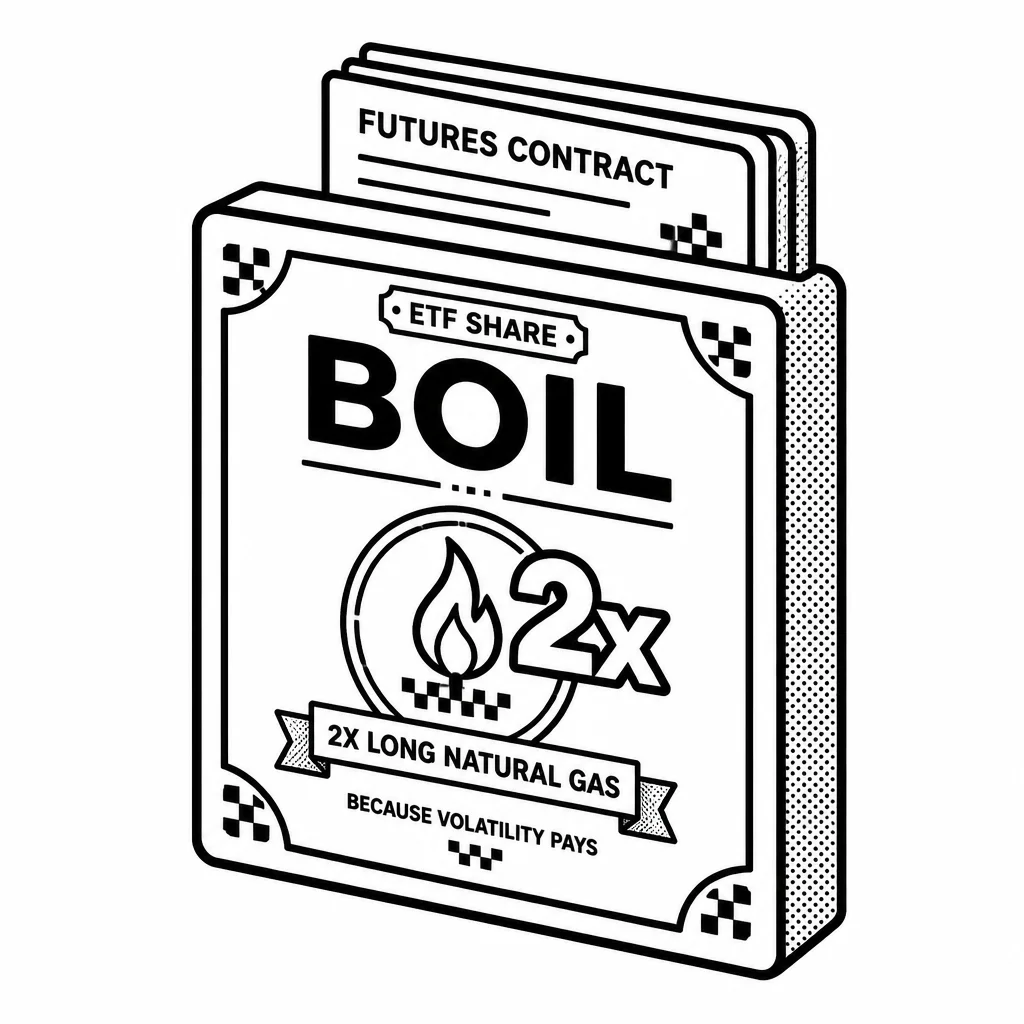
The "2x" part is the whole point. Every day, the fund aims to move twice as much as its benchmark. If natural gas futures rise 3% on a day, the fund tries to rise about 6%. If they fall 3%, it tries to fall about 6%. That leverage is reset daily, which sounds small but matters enormously over time. Here is the basic problem the fund solves: natural gas prices are wildly jumpy, and some traders want a bigger swing than the raw commodity offers. Owning futures directly is a hassle — margin accounts, contract sizes, rollovers. This fund wraps all of that into one ticker you can buy like a stock. But the daily reset cuts both ways. In a choppy market that ends roughly flat, the fund can still lose money, because two steps forward and two steps back on a leveraged base erodes value. It is built for short-term trading, and holding it for years has historically been punishing.
The other big catch is how futures behave. When the fund rolls expiring contracts into new ones, it can bleed money if the market is in "contango" — meaning later-dated gas costs more than near-dated gas. Natural gas is famous for this. Add ProShares' management fee on top, and the fund has a long record of steep decline: in 2020 it did a reverse share split to keep its price from collapsing toward zero. Its natural customers are tactical traders and hedgers, not long-term investors, and the plain warning on the label is that this is a sharp tool with a short shelf life.
Saved answer · last researched 16 Nov 2026