Understand any stock in simple English
Enter a ticker to learn what the company does and how it makes money.
Eternal Limited
Blinkit runs a network of small warehouses that deliver groceries and daily essentials to Indian households in about ten minutes.
Blinkit is an instant delivery service. You open an app, order milk, bread, snacks, or a phone charger, and a rider shows up at your door in roughly ten minutes. It works because the company keeps hundreds of small, dark warehouses — "dark stores" that look like tiny supermarkets but are closed to walk-in customers — scattered across the neighborhoods it serves. When you order, the nearest store packs your bag and a rider races it to you. The magic is proximity: goods sit minutes away from millions of homes, not hours away in a giant warehouse on the edge of town.
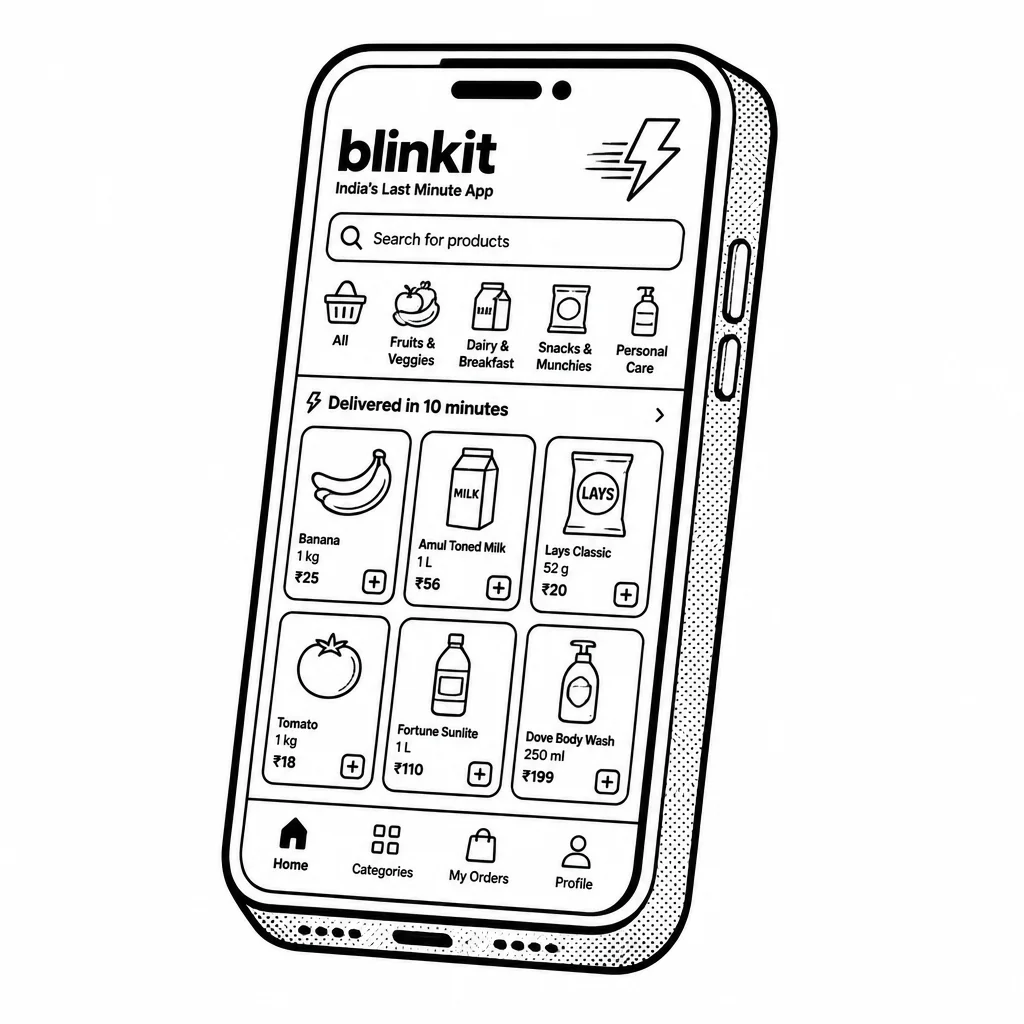
The business name you see on the app is Blinkit, but the company behind it is Eternal Limited. Eternal used to be called Zomato, the food delivery giant, and it renamed itself in 2025 to reflect that it now runs several businesses under one roof. Those include food delivery, Blinkit's instant commerce, and a business-to-business supplies arm. So when people say "Blinkit the company," they really mean Eternal — the listed parent on the National Stock Exchange of India. Blinkit makes money by selling you the groceries, earning a margin on each item, and charging small delivery fees. It also sells prime spots and ads to brands that want their products featured at the top of the app, which is a high-margin extra. The appeal to customers is brutal simplicity: no planning, no trip to the store, no waiting a day for an online order. Speed itself is the product. Competing in this space are quick-commerce rivals like Swiggy and Zepto, plus the giant e-commerce players Amazon and Flipkart in broader online retail.
The tricky part is that ten-minute delivery is expensive to run. Each dark store needs rent, staff, and inventory, and the economics only work when order volumes are high enough to spread those costs. Blinkit has been scaling fast, expanding its store count and adding more categories beyond groceries, while its parent pours money into the buildout. The bet is that once the network is dense and customers are hooked on the speed, the margins follow. It is a volume game with a convenience story on top — and one of India's most closely watched experiments in whether ultrafast delivery can actually turn a profit.
Saved answer · last researched 14 Nov 2026