Understand any stock in simple English
Enter a ticker to learn what the company does and how it makes money.
iShares MSCI ACWI ETF
It is a fund that holds a broad basket of large and mid-sized stocks from developed and emerging markets, giving investors one simple way to own a slice of the global stock market.
The iShares MSCI ACWI ETF is a single investment that lets you own a tiny piece of roughly 2,000 large and mid-sized companies across the world — from American tech giants to Japanese manufacturers to banks in Brazil. Instead of picking stocks yourself, you buy shares of the fund, and it does the diversifying for you. "ACWI" stands for All Country World Index, and that is the promise: one ticket, global exposure.
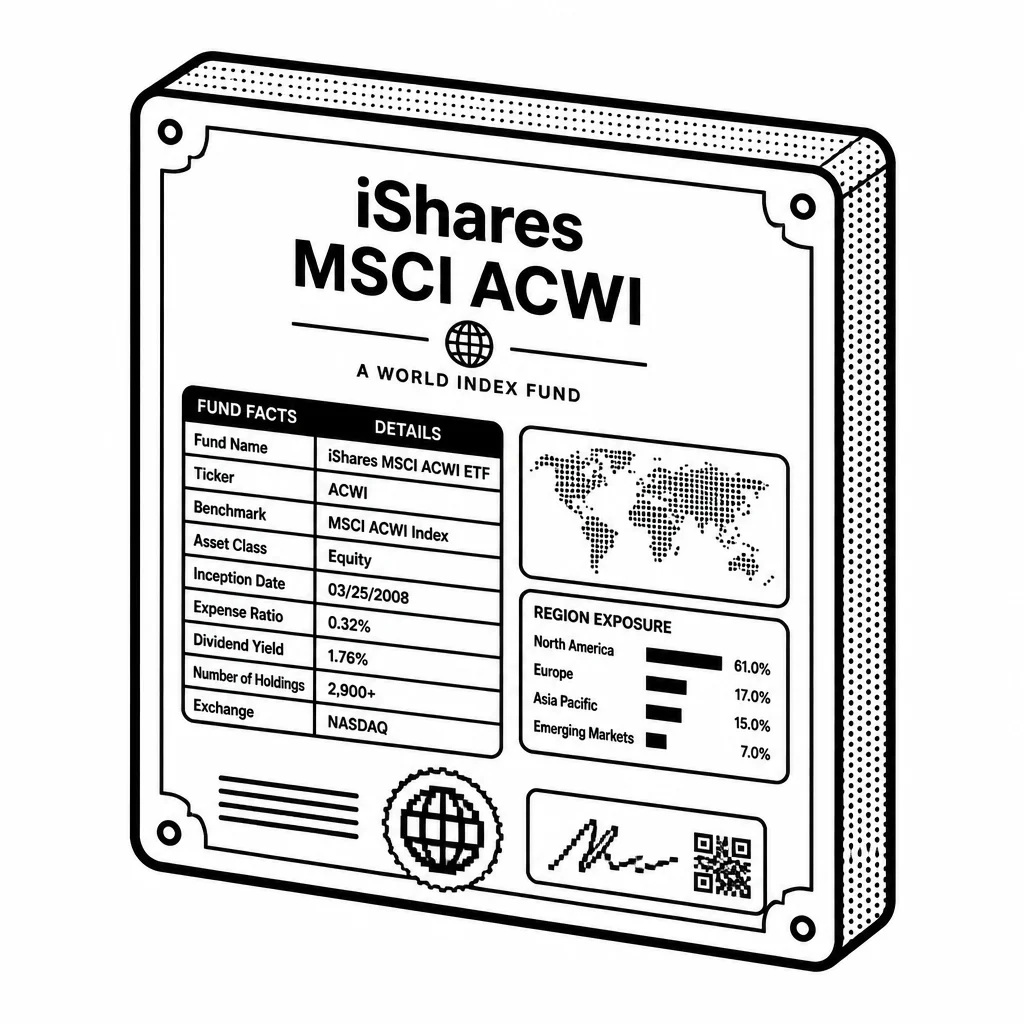
The fund tracks an index built by MSCI, a company that designs stock market benchmarks. That index covers both developed markets like the US, Europe, and Japan, and emerging markets like China, India, and Taiwan. So when you own this fund, you are not betting on one country or one industry — you are betting on the global economy broadly. It is sold to everyday investors, financial advisors, and institutions who want that wide exposure without buying dozens of individual stocks. The business behind it is iShares, the giant ETF brand run by BlackRock, the world's largest asset manager. iShares earns money by charging a small annual fee, a tiny percentage of the money invested, rather than by selling a product once. That fee looks trivial per dollar, but spread across hundreds of billions in assets it adds up to a steady, reliable stream of revenue for BlackRock. This fund is one small part of that much larger machine.
For the investor, the appeal is simplicity and low cost. You get instant diversification, easy buying and selling on the NASDAQ exchange, and a fee that is a fraction of what an actively managed fund typically charges. The trade-off is that you own the whole market, the winners and the laggards alike, so you will never beat the market — you will simply match it. For a lot of people, that is exactly the point.
Saved answer · last researched 15 Nov 2026