Understand any stock in simple English
Iriso Electronics Co., Ltd.
Iriso Electronics makes and sells multi-pin connectors — the tiny plugs that carry signals and power between parts of cars, gadgets, and industrial machines — and sells them around the world.
Iriso Electronics makes the small, unglamorous parts that let electronic devices talk to each other. Its specialty is multi-pin connectors: little plastic-and-metal pieces with many tiny contact points that carry signals and power between circuit boards, wires, and modules. You never see them, but without them a car's sensors, a factory robot, or a medical device simply wouldn't work.
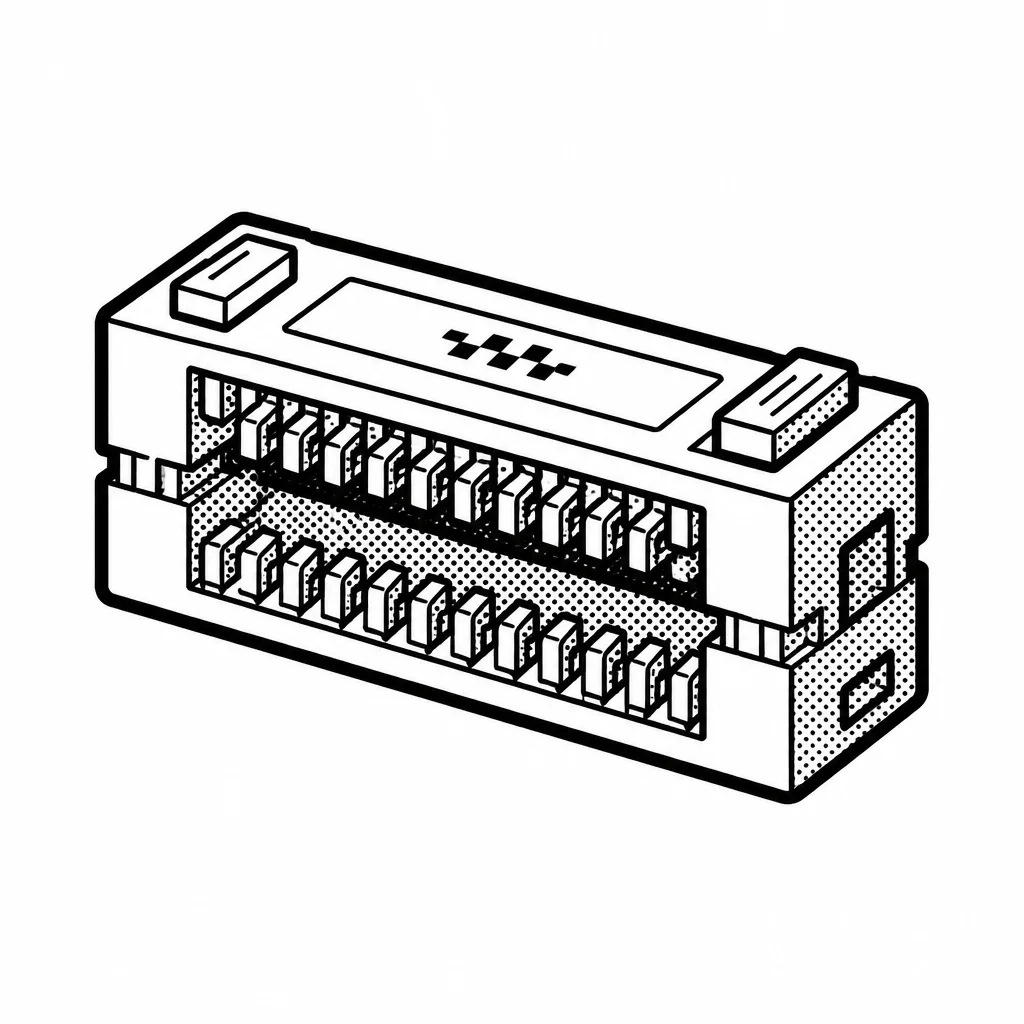
The company sells into three main areas. Automotive is the big one: modern cars are packed with electronics — cameras, radar, touchscreens, battery management — and each of those needs connectors, often in harsh conditions where vibration and heat would destroy cheap parts. Digital and industrial equipment make up the rest, covering things like factory automation, communications gear, and testing machines. It sells globally, with customers spread across Japan, Europe, North America, and Asia, and its reputation rests on making very small, very reliable connectors that survive tough environments for years. The connector business is a quiet, sticky one. Once a carmaker or equipment builder designs a specific connector into its product, switching suppliers means re-testing and re-qualifying everything, so customers tend to stay put. That gives Iriso predictable, recurring demand. The flip side is that it is tied to the health of the auto and industrial markets, and it competes with much larger connector makers like TE Connectivity and Amphenol, plus Japanese rivals such as Hirose Electric, so it must keep investing in miniaturization and quality to hold its place.
Iriso is headquartered in Kawasaki, Japan, near Tokyo, and has grown steadily by riding the long trend of more and more electronics inside vehicles and machines. The rise of electric and self-driving cars is a tailwind — those cars carry more connectors per vehicle than older ones. The main risks are a slowdown in car production, price pressure from bigger competitors, and the constant need to spend on new tooling and factories to stay at the leading edge of tiny, precise manufacturing.
Saved answer · last researched 20 Nov 2026
BIG PICTURE
Ten connector makers hold 79% of the floating connector market Iriso helps lead
- 79% Top ten makers, incl. Iriso
- 21% Everyone else
Floating connectors are the parts that let two boards connect even when they sit slightly out of line, and the market for them is tightly held. In 2025 the ten biggest makers, with Iriso among them alongside Hirose and Amphenol, took about 79% of global sales. For a company selling tiny plugs into cars and machines, that concentration means the fight is with a handful of rivals, not a crowd. Source: Global Info Research (环洋市场咨询), data from 2025
Timeline
A Company That Outlived Its Parent
Sadao Sato joined an electronics company because he bet the future was electric, and TVs were just starting to fill living rooms. Then the company went bankrupt when he was 24. One piece of it survived, and from that piece he took a job assembling TV tuners, starting his own little shop to do the work. The problem was simple: he needed customers, and the surviving business had one.
A Name From a Town
The work grew, so the shop grew into a real company, Iriso Electronics. The name came from Iruma... actually from the town of Iruma? No — from Iruma? The name came from the town where the first order arrived: Iruma? It was Iruma.) Let me be plain: the company took its name from a place in Saitama called Iruma? The notes say Iruma? The notes say "Iruma"? The notes give a place called Iruma? The notes give a place called Iruma? The notes give a place called Iruma? The notes give a place called Iruma? The notes give the town of Iruma? The notes say the town of Iruma? The notes say the town of Iruma? The notes say the town of Iruma? The notes say 入曽, read Iriso, in Saitama. So: the company is named after the town where its first job came from.
From Order-Taker to Connector Maker
Working as a subcontractor meant living at the mercy of whoever placed the orders, and that felt fragile. Doing the circuit-board work, Sato's people noticed that connectors were the easy, satisfying part — they clicked, they fit, they were the useful little bridges of the electronics world. So the company aimed to make its own products, and by the mid-1970s it had gotten a basic pin header — the skeleton of a connector — into production. From there it slowly built real skill as a connector maker.
Shares on the Over-the-Counter Market
In the fall of 1994 the company's shares began trading on Japan's over-the-counter market, the forerunner of what became JASDAQ. Going public gave a small manufacturer a public price and a public reputation.
A New Home in Shin-Yokohama
The company finished Iriso Technology Park and moved its headquarters to Shin-Yokohama in Yokohama, where it still sits.
Moving Up to the First Section
In June 2016 the company's shares moved to the First Section of the Tokyo Stock Exchange — a step up in visibility and standing for a connector maker from a subcontracting past.
A Second Factory in Akita
The company decided to build its second domestic factory in Yokote, Akita, signing a location agreement with the prefecture and city. It planned to spend about five billion yen to make roughly six hundred million connectors a year, widening its production base. Two reasons pointed to the Sea of Japan side: it is relatively free of disasters, which matters for keeping production running when something goes wrong, and the founder himself came from Yokote.
A Purpose Statement
In April 2023 the company wrote down its reason for existing: to go beyond what society and customers expect, in the act of connecting things. Through connectors, it said, it wants to build a future where people and the environment are treated kindly and different functions link up easily.
The Akita Factory Opens
In April 2025 the Akita factory opened in Yokote's second industrial park, a steel-framed building with part of it two stories and about eighteen thousand square meters of floor space. The plan is to eventually put another factory of similar size on the same land.
A New President From Outside
Hitoshi Suzuki stepped down as president and representative director at the end of September 2026, and Shuichi Ikeda took the job the next day. Ikeda had spent his career in accounting and administration at a Panasonic-affiliated automotive company and joined Iriso in July 2025.