Understand any stock in simple English
Enter a ticker to learn what the company does and how it makes money.
JD Health International Inc.
JD Health runs an online pharmacy and healthcare platform in China, selling medicines and connecting people to doctors.
JD Health is China's biggest online pharmacy and a growing source of online doctor visits. You open its app, buy medicine, get it delivered to your door, and if you need advice you can also message a doctor or book a video consultation. It is the healthcare arm of the giant online retailer JD.com, spun out of its parent's pharmacy business and listed on the Hong Kong stock exchange in late 2020.
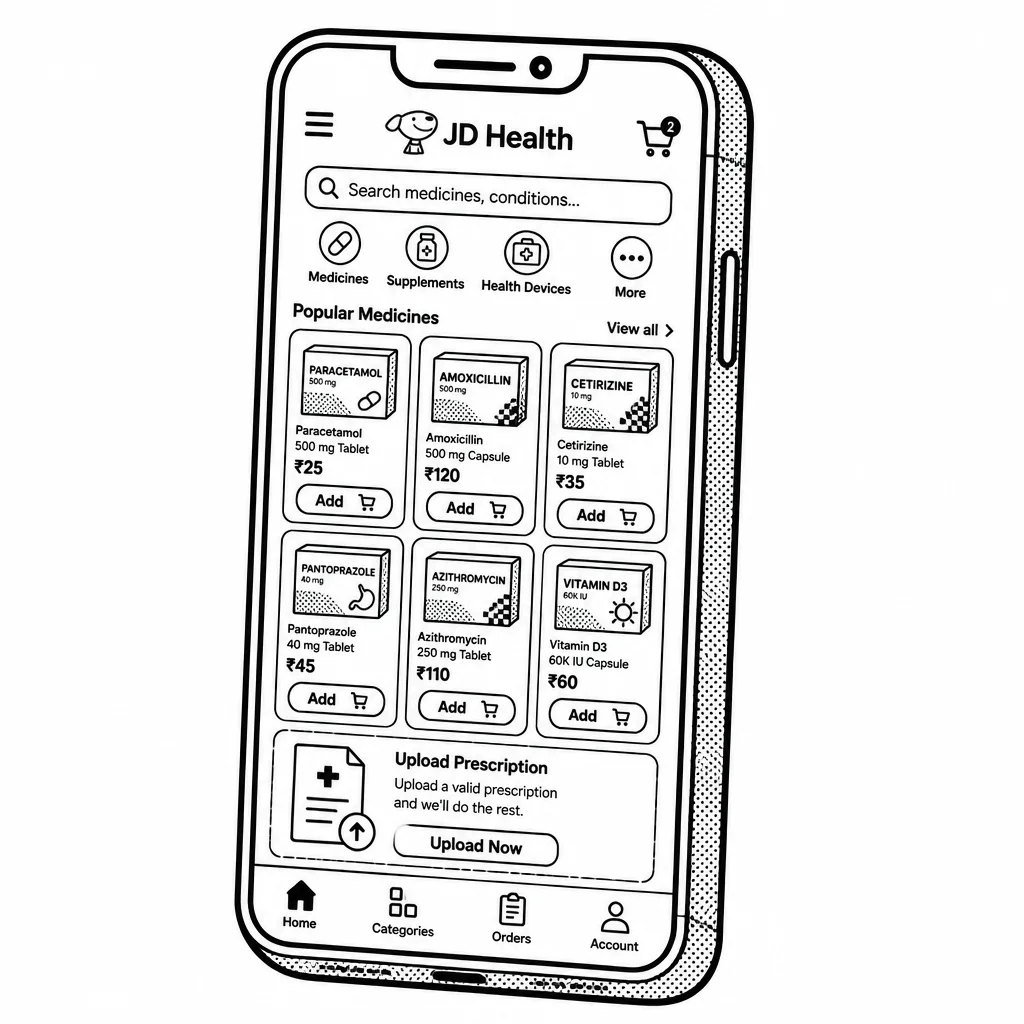
The core of the business is simple: it buys drugs and health products from manufacturers and distributors, sells them online, and keeps a margin on each sale. That includes prescription medicines, over-the-counter drugs, supplements, and medical devices. Around that retail engine it has built services that make the app sticky — online consultations with licensed doctors, a prescription refill service, and health checkup bookings. The smart part is the loop: a customer comes for a cheap consultation, gets a prescription, and buys the medicine in the same place. That convenience is why people choose it over standing in line at a hospital pharmacy, where queues are long and appointments are hard to get. JD Health's real edge is its parent's logistics network. JD.com built one of China's best delivery systems, with warehouses and couriers reaching most cities, so JD Health can promise fast delivery of medicines — often same-day in big cities. That is hard for a pure app to copy. Its main rivals are Alibaba's health arm, Alibaba Health Information Technology, and Ping An Good Doctor, Ping An Healthcare and Technology, each tied to a big parent too. China's online drug rules are the swing factor: regulators have gradually allowed online sales of prescription drugs, which is a huge market, but they also keep tightening rules on how those drugs can be sold and advertised. A change in policy can move the whole business.
The company is solidly profitable now, after years of losing money as it spent to grow. It has poured cash into expanding its own network of offline pharmacies and medical clinics, and into building out its doctor roster and specialist services. The bet is that healthcare in China is shifting online, and the company that owns the customer relationship — from first symptom to medicine delivery — captures the most value. The risk is that the Chinese government treats healthcare as a public good and keeps squeezing margins, so JD Health has to keep proving it can add services that people actually pay for.
Saved answer · last researched 12 Nov 2026