Understand any stock in simple English
Enter a ticker to learn what the company does and how it makes money.
Nomura Micro Science Co., Ltd.
Nomura Micro Science builds ultra-pure water systems that chipmakers and other factories need to keep their products clean.
Nomura Micro Science builds the water systems that factories rely on when "clean" is not clean enough. A semiconductor plant cannot use ordinary water to rinse a silicon wafer, because even a microscopic speck of impurity can ruin a chip. Nomura Micro Science designs and installs ultra-pure water systems — equipment that filters water down to almost nothing but H2O — so chipmakers can wash their products without contaminating them.
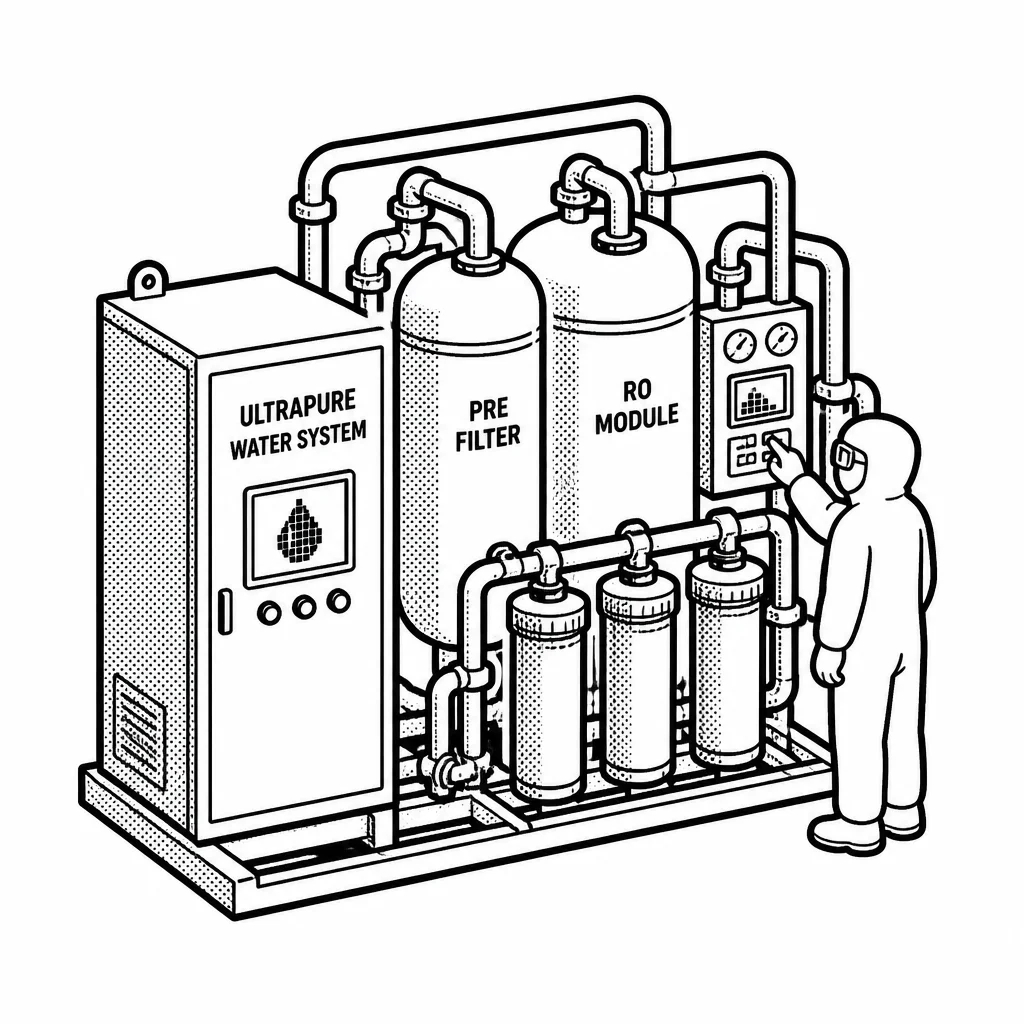
The company sells to more than chipmakers. Its water treatment and purification equipment also serves pharmaceutical, food, and environmental businesses, where water quality matters just as much. Customers buy the systems up front, and Nomura Micro Science also makes money from maintenance, replacement parts, and consumables like filters and membranes that need to be swapped out regularly. That recurring service business helps smooth out the lumpiness of big equipment orders. Its natural home is Japan, where it sits in the supply chain of the country's giant electronics and chip industry, but it has expanded overseas as chipmakers build fabs in other parts of Asia and the United States. The tie to the chip industry cuts both ways: when semiconductor makers spend heavily on new plants, demand for water systems rises with them, but when chip investment slows, equipment orders can cool quickly. Nomura Micro Science is headquartered in Atsugi, Japan, and is listed on the Tokyo Stock Exchange.
One useful way to see the business: water is the quiet utility of the electronics world. A modern chip fab uses enormous volumes of it, and every drop has to be cleaner than what comes out of your tap by a wide margin. Companies like Nomura Micro Science exist because making that water reliably, day after day, is a specialized engineering problem — and one that factories cannot afford to get wrong.
Saved answer · last researched 16 Nov 2026
BIG PICTURE
One industry pays for 93 percent of Nomura Micro Science's sales
- 93.2% Semiconductor customers
- 6.8% Other industries
In its latest full year, chips and display makers put up 93.2 percent of the company's revenue. Nomura builds the ultra-pure water systems that rinse silicon wafers between production steps, and chip fabs are the customers that keep ordering them. The rest of the business, from other factories to maintenance work, is small change by comparison. Source: Wantstats, data from 2025
Timeline
A Membrane Sample Changes Everything
General Electric had made a precision filtration film called the Nuclepore Membrane, and a sample of it ended up in the hands of a man named Nomura Kozo, who grabbed the Far East distributorship rights. In 1969 he founded Nomura Micro Science, backed by two parent companies and a small pile of capital, with a simple mission: sell that membrane in Japan. Kozo became the first president, and a director named Machii drew the company emblem that is still used today.
The Company Cuts the Cord
Four years in, the young firm took over the people and equipment of Hokko Chemical's Nuclepore department, folding manufacturing and sales of the membrane and its related gear into one operation. That made it independent of its parent and gave it something more valuable than a product line: its own engineering base.
Borrowing Ultrapure Water From America
The next year brought a bigger pivot. The company licensed Ultrapure Water technology from Aqua Media in the U.S. and jumped into the ultrapure water business, the very thing it is known for today.
A Lab Job That Made the Big Three
Then came the break that put it on the map: a delivery of an ultrapure water system to NTT's Musashino Communication Laboratory, a leading-edge chip research site. That job stamped the company as one of the big three pure water firms and flung open the door to the electronics and semiconductor market.
First Step Into Korea
In 1983 the company shipped an ultrapure water system to Samsung Semiconductor in South Korea. It was a small export at the time, but it began the overseas push that would later become central to growth.
Joining the Stock Market
On the fifth of October in 2007, the company listed on the JASDAQ Securities Exchange under code 6254, and its capital rose to just over two billion yen. It was a public company now.
Samsung's Boom Lifts a Middling Firm
For years the company had been a struggling mid-size engineering outfit. Then Samsung Electronics went on a semiconductor building spree, and Nomura Micro Science rode the wave, piling up a track record through Korean and U.S. projects. That was the shift from plodder to growth company.
Climbing to the Prime Market
After working its way up the exchange tiers, the company landed on the Prime Market of the Tokyo Stock Exchange in April 2022. It now sat among Japan's blue chips.
The Re-Rating Nobody Saw Coming
Even after all that, the stock traded at a PER of just five to seven times earnings, as if nothing good were expected. Then in October 2023 the company sharply raised its earnings forecast, sales and operating profit surged, and the share price roughly quadrupled within months. The market had been asleep at the wheel, and it woke up hard.
A Dip in Sales, a Jump in Profit
The fiscal year ended March 2026 told a strange story: sales fell by more than 40 percent as large U.S. orders slipped, yet operating profit tripled thanks to higher-margin services and cost control. Management guided the next year's sales to nearly double and forecast a huge surge in orders, betting on a semiconductor capex recovery. The stock hit a daily limit up on the results, with the market clearly pricing in the comeback.