Understand any stock in simple English
Enter a ticker to learn what the company does and how it makes money.
InSilico Medicine Cayman TopCo
Insilico Medicine uses artificial intelligence to discover and design new drugs, and it also sells the AI software behind that work to other drug companies.
Insilico Medicine is a drug discovery company that uses artificial intelligence to do the slow, expensive parts of finding new medicines. Instead of chemists testing thousands of molecules by hand, its software proposes which molecules might work, predicts whether they will be safe, and helps design them from scratch. The company's lead bet is a drug for a scarring lung disease called idiopathic pulmonary fibrosis, which has finished mid-stage human trials — a striking milestone for a medicine designed largely by AI.
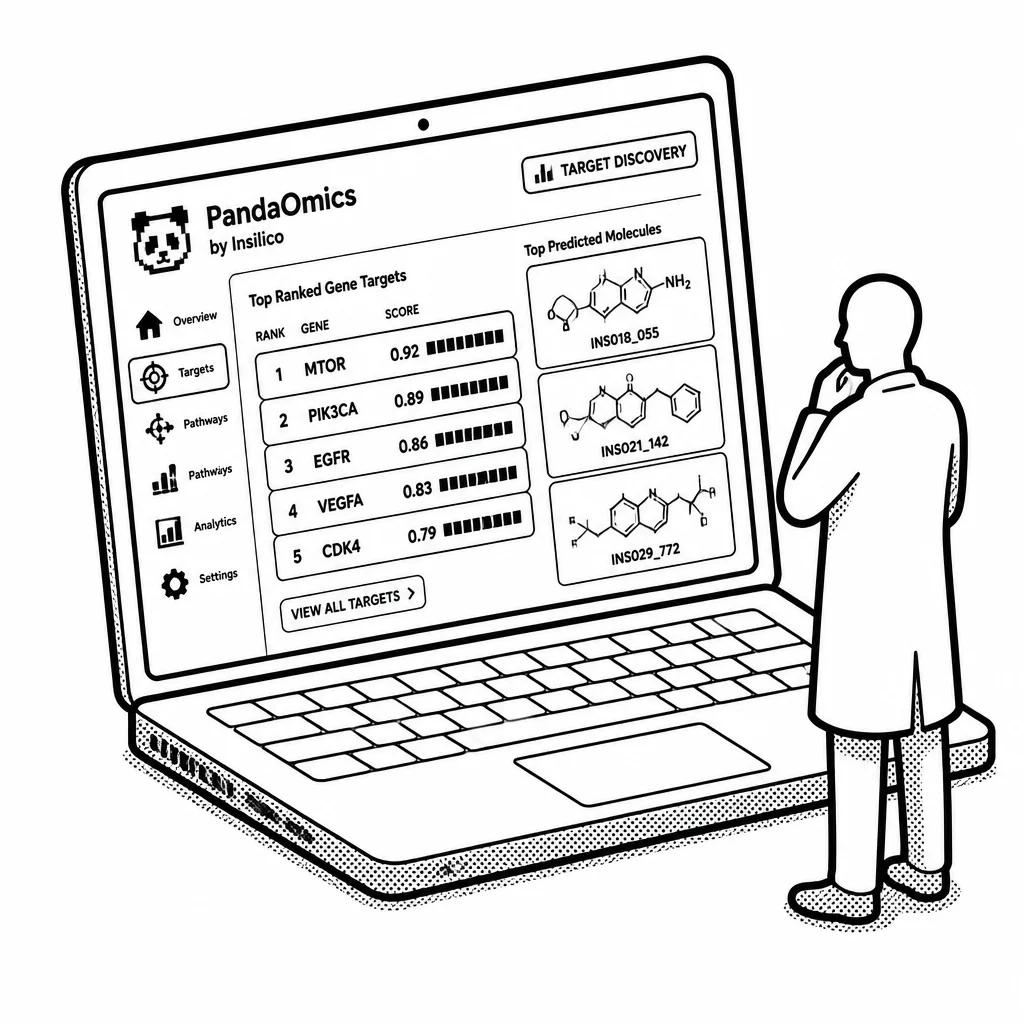
There are two ways money comes in. One is the traditional drug route: if its treatments win approval, it sells them and collects revenue, sharing the risk and reward with partners. The other is a service business: Insilico sells access to its AI platform — its molecule-generation and drug-property prediction engines — to other pharmaceutical companies that want to speed up their own pipelines. Its pitch to customers is simple: cut years off the discovery stage and waste less money on dead ends. The company listed on the Hong Kong Stock Exchange in 2025, raising money to push its drug candidates through costly clinical trials and to expand its software. Being public means its value now swings on trial results and partnership deals, not just on steady software subscriptions. Its big risk is that AI-designed drugs are still unproven at the final regulatory stage — one late-stage failure could shake confidence in the whole approach.
Competition comes from AI drug discovery upstarts and from large pharma companies building their own AI teams, including Eli Lilly and Novartis, which have signed deals with such firms. Insilico's edge is that it has taken its own AI-designed molecule further into human testing than most rivals, which is real proof it can do more than make promises.
Saved answer · last researched 8 Nov 2026
BIG PICTURE
Insilico's AI has named 35 drug candidates since 2021, a pace few labs can match
- 35% Drug candidates named by Insilico since 2021
- 65% Not disclosed
On October 13, 2026, Insilico named its 35th drug candidate since 2021, a molecule for autoimmune diseases like inflammatory bowel disease and rheumatoid arthritis. Most biotech firms move through candidates slowly and at great cost; Insilico's AI platform, Pharma.AI, is what lets it churn them out. The company makes money by licensing these molecules to partners and selling the software that finds them. Source: Simply Wall Street, data from 2026
Timeline
A Physicist Bets on AI and Biology
Dr. Alex Zhavoronkov had spent years jumping between business, biotechnology and physics, and that mix of backgrounds gave him an unusual idea: what if computers could do the slow, expensive thinking that drug discovery demanded? In 2014 he founded the company and started operating through Insilico Inc. in Delaware. The bet was simple in theory and huge in practice — teach machines to find new medicines.
A Drug Candidate in Eighteen Months
The idea stopped being a pitch and became a result. Using its platform, which it called Pharma.AI, the company went from a fresh idea to a preclinical candidate compound in just 18 months — a novel target for fibrosis and a candidate drug for idiopathic pulmonary fibrosis. Conventional drug hunting can take years for that same step, so this was the proof that mattered: the machine could compress the clock.
First AI-Drug IPO Filing in Asia
With a working platform behind it, the company reached for public money, filing for a Hong Kong IPO in June 2023 — the first filing of its kind in the Asia-Pacific AI-drug space. It was a statement as much as a fundraising move. But the attempt did not complete, and the company would have to come back and try again.
Refiling, Still Pre-Revenue
The company returned to the Hong Kong Stock Exchange in March 2024 after the earlier attempt lapsed. The refiling laid bare an awkward truth: it still had no revenue from its own drug candidates, leaning instead on out-licensing deals and payments from partners. The platform worked; the business model was still proving itself.
Hong Kong's Biggest Biotech IPO of 2025
Then the wait paid off. On the last trading day of 2025, the company listed on the Hong Kong main board at HK$24.05 a share, raising about $290 million. Investors wanted in badly — the offering was oversubscribed more than 1,400 times, pulling in over HK$328 billion in orders and making it Hong Kong's biggest biotech IPO that year. Cornerstone backers like Eli Lilly, Tencent, Temasek, Schroders and UBS put real weight behind the AI-drug story.
A Servier Cancer Deal Weeks After Listing
Fresh public money did not sit idle. Within weeks of the IPO, the company signed a multi-year cancer drug discovery deal with France's Servier worth up to $888 million, with InSilico getting up to $32 million in upfront and near-term payments. Its Pharma.AI platform would work alongside Servier's oncology know-how — a public company now selling its engine to the industry.
First Profit, and Cash to Spare
The deals turned into money. Revenue jumped 287% year-over-year to $106.3 million, and the company posted its first-ever profit — $35.5 million — driven by out-licensing, a $2.75 billion Eli Lilly partnership, and clinical milestones. With $585 million in cash, the long-standing fear of burning through money faded. The company that once had a platform and no revenue now had both.