Understand any stock in simple English
Enter a ticker to learn what the company does and how it makes money.
HD Hyundai Co., Ltd.
HD Hyundai is a South Korean industrial giant whose subsidiaries build ships, refine oil, make construction equipment, and produce electrical gear and robots.
HD Hyundai is a South Korean conglomerate that builds some of the biggest, most expensive machines on earth: giant ships, excavators, and the electrical equipment that keeps factories and grids running. It also owns one of the country's large oil refiners. You almost never buy anything from HD Hyundai directly. Its customers are shipping lines, construction firms, energy companies, and utilities.
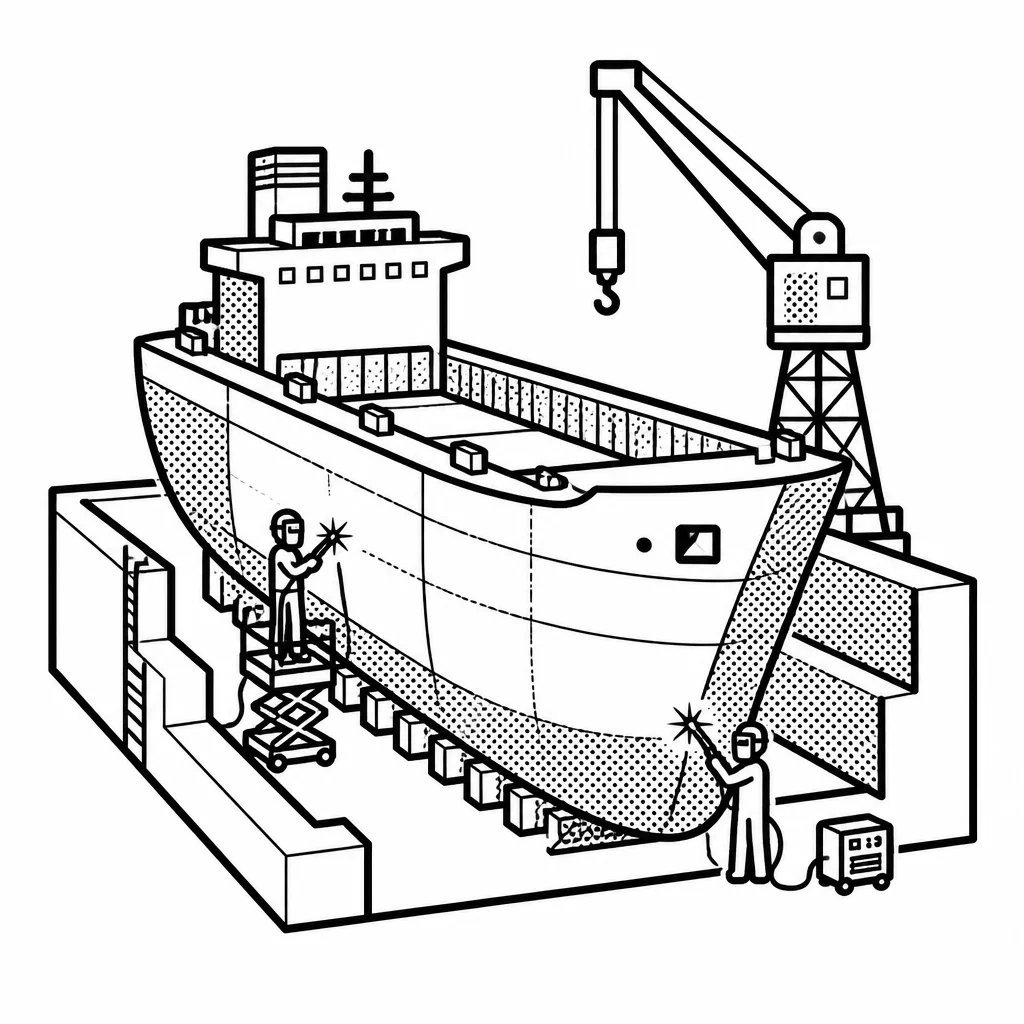
The company works like a holding company. It sits on top of separately run businesses and owns big stakes in them. The most famous is HD Hyundai Heavy Industries, one of the world's largest shipbuilders, which makes tankers, container ships, and increasingly specialized vessels for offshore energy. Another arm, HD Hyundai Oilbank, refines crude oil into gasoline and diesel. HD Hyundai Infracore and its construction-equipment business make the excavators and wheel loaders you see on building sites, while HD Hyundai Electric builds transformers and switchgear — a business that has surged as data centers and power grids strain for equipment. If there is one thread connecting these pieces, it is heavy industry that helps the world move energy and build things. Ships carry oil and goods, refineries turn crude into fuel, and electrical gear moves the power. The robots and automation arms are a newer bet on where manufacturing is heading. Customers choose these units on engineering, delivery time, and price against rivals like Samsung Heavy Industries and Hanwha Ocean in shipbuilding, or Caterpillar in construction equipment.
The stock itself is a way to own a slice of Korea's industrial base rather than a pure growth story. Shipbuilding is famously cyclical — orders boom, then dry up. Refining margins swing with oil prices. That mix of businesses is the point: when one part is weak, another can carry the group. The company returns cash to shareholders partly through dividends and has also bought back and cancelled shares in recent years, a deliberate move to shrink the share count and lift the value of each remaining share.
Saved answer · last researched 12 Nov 2026
BIG PICTURE
韩国造船厂下单的每10台船用发动机中,近7台来自HD Hyundai Marine Engine
- 74.2% 订单来自中国造船厂
- 25.8% 订单来自其他造船厂
2026年上半年,HD Hyundai Marine Engine签署的船用发动机合同中,按金额计算有74.2%是与等待发动机的中国造船厂签订的。中国造船厂赢得了大量新船订单,但国内发动机制造商无法以足够快的速度生产大型双燃料发动机,因此缺口流向了韩国。HD Hyundai向竞争对手国家的船厂供应核心设备,这一事实表明其在船舶发动机领域的领先地位有多牢固。 Source: HanS Economy (한스경제), data from 2026
Timeline
The Turtle Ship Loan
Chung Ju-yung wanted to build Korea's first big shipyard, but banks in the U.S. and Japan turned him down. So he showed a British banker the turtle ship on a 500-won banknote and made a simple case: Koreans built ironclad warships centuries before anyone else. It worked. The loan broke ground on the Ulsan shipyard in 1972, and that yard became the seed of one of the world's largest shipbuilding groups.
Hyundai Shipbuilding Is Founded
The Ulsan project, started in a fishing village, grew into its own company in late 1973, with Chung Ju-yung as CEO. What began as one yard was now the first real step toward Korea becoming a shipbuilding nation.
A New Name, A Bigger Ambition
Five years in, the company renamed itself Hyundai Heavy Industries. The new name said it plainly: this was no longer just a shipyard, but a company that wanted to build all kinds of heavy things.
Two Mergers, One Company
Hyundai Heavy Industries absorbed its electrical engineering and heavy machinery arms. The move turned it into a full heavy-industries company split into divisions, well beyond ships.
Listed on the Korea Exchange
The company went public on the Korea Exchange, opening its ownership to outside investors and giving it a new source of capital for growth.
Out of the Hyundai Group
The company split off from the wider Hyundai Group and launched its own group. Soon after, it bought Halla Heavy Industries and set up Hyundai Samho Heavy Industries, adding a second shipbuilding force. It was now standing on its own, and bigger.
The Offshore Plant Losses
Costs rose and construction ran late on big offshore plant projects, and the company took heavy operating losses. A long shipbuilding downturn, fast-rising Chinese shipbuilders, and labor fights over restructuring all cast a shadow. The good years had hidden how fragile the business could be.
A Holding Company Takes Shape
The group reorganized around a new holding company, HD Hyundai in all but name, to oversee its growing collection of businesses. A year later, a separate company was set up to run the shipbuilding side, so the group's structure could keep up with its size.
Chung Ki-sun's First Big Bets
Chung Ki-sun, the founder's grandson, had already built HD Hyundai Marine Solution, a ship repair and retrofit unit, into a large, valuable business. Then he led the purchase of Doosan Infracore, making construction equipment a major group business. A new generation was putting its stamp on the company.
Dropping 'Heavy Industries'
The holding company renamed itself HD Hyundai Co., Ltd., cutting the words 'heavy industries' from its name. That was the point: the group wanted to be seen as more than shipyards and machines, and to move into future industries.
The Owner Returns as Chairman
Chung Ki-sun was promoted to chairman, ending 37 years of management by professional executives and putting the founding family back in charge. He merged the big shipbuilder with Hyundai Mipo and combined the construction equipment units, while pushing into power for AI data centers and small modular nuclear reactors.
A Warship Built Without an Order
HD Hyundai teamed up with the U.S. defense firm Anduril to launch a 600-ton unmanned surface vessel, built in about a year without waiting for a navy to order one. It pairs HD Hyundai's shipbuilding and autonomy tech with Anduril's AI, aiming at the U.S. Navy's unmanned vessel market. The bet: naval defense and autonomous ships as a new growth engine, with a goal of 10 trillion won in special ship revenue by 2035.