Understand any stock in simple English
Enter a ticker to learn what the company does and how it makes money.
E-MART Inc.
E-Mart runs a chain of supermarkets and discount stores in South Korea, selling groceries, household goods, electronics, and clothing to everyday shoppers.
E-Mart is South Korea's biggest discount supermarket chain. Think of it as the Korean answer to Walmart or Target: a place where families push a cart through wide aisles and load up on rice, kimchi ingredients, toilet paper, cheap T-shirts, and a new rice cooker, all under one roof. It opened its first store in 1993 in Seoul and grew into a national network of "E-Mart" hypermarkets, plus smaller neighborhood outlets and specialty shops.
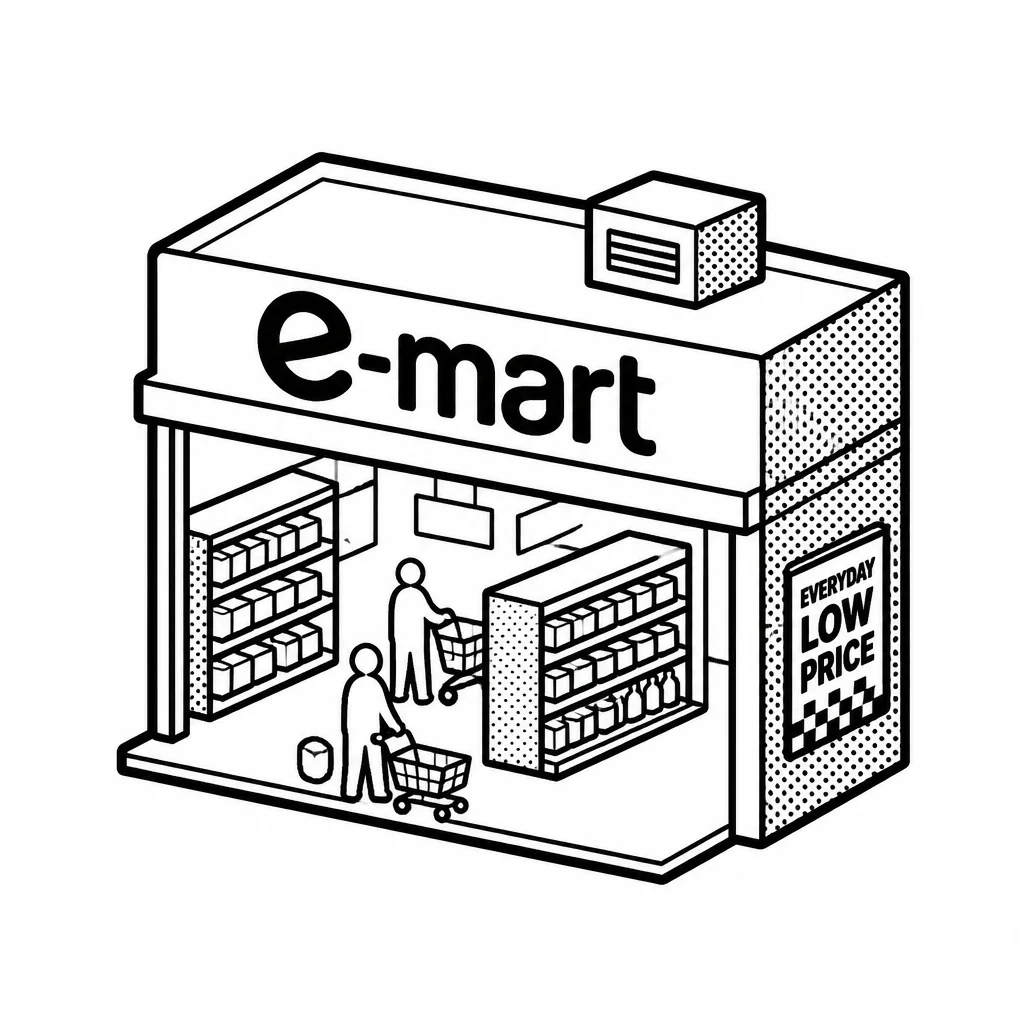
The core of the business is simple retail math. E-Mart buys goods in huge volumes straight from manufacturers and farmers, often under its own private labels, and sells them at prices low enough to pull customers away from traditional markets and smaller shops. Shoppers pay at the register, and E-Mart keeps the difference between what it paid and what it charged. Because groceries are low-margin and heavily price-sensitive, the company lives on volume and cost control, squeezing suppliers and building efficient distribution and logistics. Its own-label brands, like No Brand, are a big lever: they cut out the middleman and carry fatter margins than branded goods. E-Mart is not just a big-box store anymore. It owns a portfolio of retail formats and brands, including the warehouse-style Traders, the outlet chain E-Mart Everyday, and specialty and pet businesses, and it has pushed into e-commerce to defend against online rivals. That online shift matters because Korean shoppers are among the world's most digital, and pure-play e-commerce players have been eating into physical retail. The company has also expanded abroad, most notably into Vietnam, where its stores have become a meaningful growth engine as the domestic market matures and competition intensifies.
Retail is a brutal, thin-margin game, and E-Mart has had to fight for every won. It competes with discount chains, big online marketplaces, and convenience stores, while rising labor costs, inflation, and a slowing Korean consumer squeeze profits. The company has responded with store remodels, cost cuts, and bets on new formats, but its results have been uneven. It is a mature, cash-generating business that pays dividends and invests in its stores and overseas expansion rather than a fast-growing story — a steady workhorse of Korean daily life that wins by being cheap, convenient, and everywhere.
Saved answer · last researched 14 Nov 2026